
Services
Tooth extractions in Orlando, FL.
We get you out of pain and plan for what comes next. Most extractions happen right here in our office, fully numbed, with sedation if you want it.
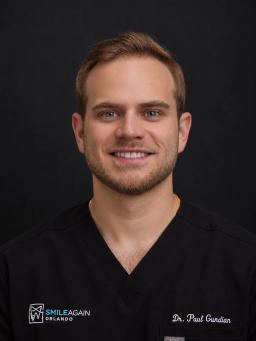
 Medically reviewed by Dr. Paul Gundian, DMD FICOI
 Sedation available
Signs you may need a tooth extracted.
Dr. Gundian always tries to save a tooth first. When decay, disease, or an injury has gone too far, removing it is the healthier choice, and the first step to fixing the problem.
- Severe tooth pain
- Jaw pain
- A cracked or broken tooth
- Bleeding or swollen gums
- Crowded teeth
- Pain when you bite or chew
In pain right now? Call us at (407) 243-8522 and we'll get you in.
Your tooth extraction, step by step.
We numb you first, with sedation if you like. Then you go home with written instructions.
Exam and X-rays
We check the tooth, its roots, and the bone around it on digital X-rays, and explain exactly what we’ll do.
Numbing and sedation
Local anesthetic numbs the area completely. If you’re nervous, nitrous oxide, oral sedation, or IV sedation helps you relax.
Gentle removal
The tooth is loosened and lifted out. A broken or impacted tooth may need a small incision.
PRF and aftercare
PRF goes into the socket to help it heal. You go home with gauze and written instructions for pain, food, and rest.
Healing and follow-up
Most people feel much better within a few days. At your follow-up we plan how to replace the tooth.
How we help the socket heal.
When a tooth comes out, the bone that held it starts to shrink, often within the first year. Every extraction here gets PRF to help the socket heal, and a bone graft when you need one.
- With every extraction
PRF from your own blood
PRF (platelet-rich fibrin) is a natural healing material made from a little of your own blood. Placed in the socket, it helps the gum and bone heal faster.
- Comes from you, so there’s nothing foreign in it
- Done at the same visit, right after the tooth comes out
- If you need it
A bone graft
A bone graft is a little bone-building material placed in the socket after the tooth comes out. It gives your own bone something to grow into, so your jaw keeps its shape.
- Gives a future implant solid bone to go into
- Goes in with your PRF, at the same visit
Dr. Gundian looks at your X-rays and tells you if a graft makes sense for your tooth. If it does, it's part of your written price before we start.
Most extractions happen right here, without a referral.
You stay in one office, with no outside surgeon to pay. The doctor who removes your tooth is the one who plans what replaces it.
In our office
We do it here, which saves you extra visits and fees at a surgeon’s office.
Sedation if you want it
Nitrous oxide, oral sedation, or IV sedation for nerves, on top of complete numbing.
One written price
You know the cost before we start, with financing if you need it.
Planned for what’s next
Your extraction is planned around the implant or digital denture that follows.
Before and after your tooth extraction.
Tell us first
Extractions are very safe. Tell us first if you have any of these, so we can plan for your safety:
- Heart damage, a congenital heart defect, or a replaced heart valve
- A weakened immune system
- Liver disease (cirrhosis)
- An artificial hip, knee, or shoulder
- A history of bacterial endocarditis
Aftercare
Good aftercare lowers the risk of infection and helps you heal faster:
- Bite gently on the gauze for 30 to 45 minutes
- No straws, smoking, or hard rinsing for 24 hours
- Ice in 20-minute stretches for swelling
- Soft foods for a few days
- Pain medicine as directed
- Sleep with your head raised
- Warm salt-water rinses after the first 24 hours
Pain getting worse, or signs of infection? Call us right away.
Replacing the tooth, planned from the start.
A gap lets your other teeth shift and the bone shrink. We plan the replacement with you before the extraction, with a written price for both.
Tooth extractions in Orlando, FL
Questions about tooth extractions.
Don’t see yours? Give us a call or send us your question.
It depends on the tooth. A simple extraction of a tooth you can see costs less than a surgical one for a broken or impacted tooth. You get a written price at your consultation before anything starts, and financing is available.
- Severe pain, swelling, a tooth broken below the gumline, or an infection that won’t clear are the common signs. Dr. Gundian takes digital X-rays and tells you honestly whether the tooth can be saved.
- It shouldn’t. We numb the area completely first, and sedation is available if you’re anxious. You may feel pressure, but not sharp pain. Some soreness afterward is normal and eases with over-the-counter pain relievers and ice.
- Most people feel better within a few days. The clot forms in the first 24 hours and the gum heals over one to two weeks. A surgical extraction can take a little longer.
- Yes. PRF (platelet-rich fibrin) is a natural healing material made from a little of your own blood. Placed in the socket, it helps the gum and bone heal faster. We use it with every extraction, and because it comes from you, there’s nothing foreign in it.
- Not always. A bone graft makes the most sense when an implant will replace the tooth, because it helps the socket keep the bone an implant needs. Dr. Gundian looks at your X-rays and tells you if a graft is worth it for that tooth. If it is, it’s part of your written price before we start.
Yes. You can choose nitrous oxide (laughing gas), an oral sedative taken before your visit, or IV sedation if you'd like to be more deeply relaxed. Each one goes on top of complete numbing. We'll go over your sedation options at your consultation.
- We’re not in-network with any dental insurance, but we’ll file your claim for you so you get the most your plan pays, and we’ll estimate what you’ll owe before we start.
In most cases, yes. A gap lets nearby teeth drift, changes your bite, and lets the jawbone shrink over time. We plan the replacement, like a single tooth implant, with you before the extraction.